
A few months ago, a friend of mine from Australia messaged me in a panic.
She’d spent three weeks planning a Phu Quoc trip for August – flights booked, resort paid for, itinerary mapped out. Then she read something online that said August was “the worst possible time to visit” and she should cancel everything.
“Dang, should I cancel?” she asked me. “Is it really that bad?”
I told her the truth: no, don’t cancel. But also – don’t expect the postcard version of Phu Quoc. August is rainy, the west coast beaches get rough, and island hopping is off the table. But if you adjust your expectations and know where to go? You can still have a genuinely great trip.
She went. She loved it. She had Sao Beach almost entirely to herself on a Wednesday morning and spent her afternoons eating her way through the Duong Dong night market while everyone else was hiding from the rain in their hotel rooms.
The point is: there’s no single “best time” to visit Phu Quoc. There’s only the best time for you – based on what you want from the trip, what you’re willing to trade off, and how much you’re willing to spend.
I’ve lived in Vietnam my whole life. I’ve been to Phu Quoc in every single month of the year – for work, for holidays, to visit friends who’ve moved to the island, and more than once just because I needed a few days somewhere warm. I know what December feels like when you’re fighting for a sunbed at Long Beach and I know what October feels like when the whole island is yours and the forests are the most impossibly green you’ve ever seen.
This is everything I know about Phu Quoc’s weather. Not the generic tropical climate overview you’ll find on every other travel site – the actual, honest, month-by-month breakdown from someone who’s been there in all of them.
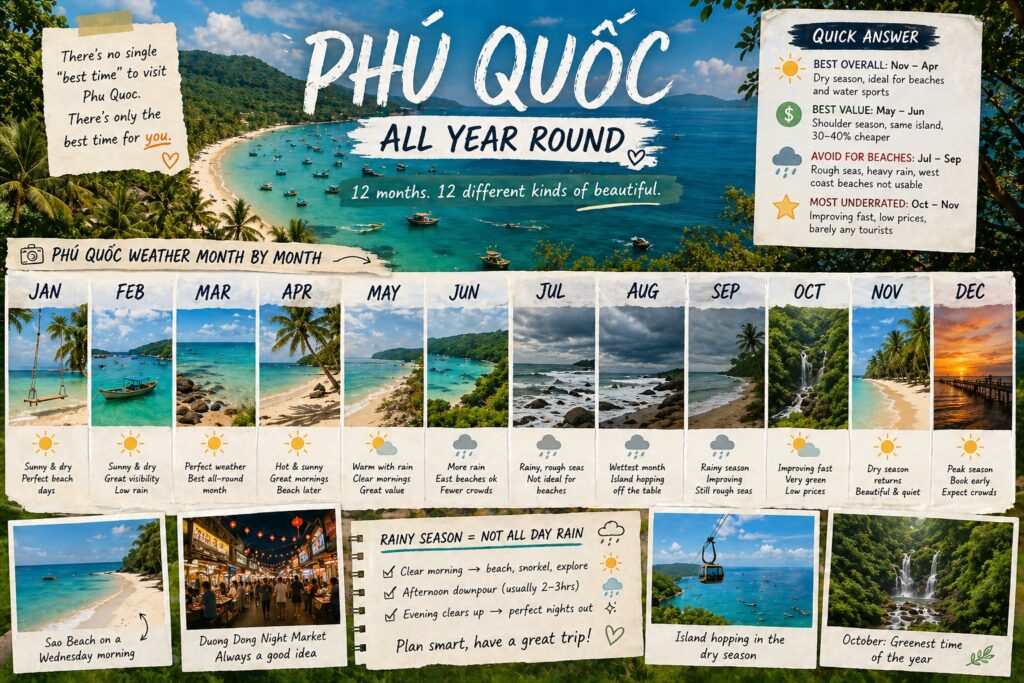
Quick answer if you’re in a hurry:
- Best overall: November to April (dry season, ideal weather for beaches and water sports)
- Best value sweet spot: May to June (shoulder season, same island, 30-40% cheaper)
- Avoid for beaches: July to September (rough seas, heavy rain, west coast beaches not usable)
- Most underrated months: October and November (improving fast, low prices, barely any tourists)
First, Let Me Kill a Myth About “Rainy Season”
Before I go month by month, I need to address something that gets written about Phu Quoc constantly and is only half true.
“Avoid the rainy season. It rains all day. You won’t be able to do anything.”
This is not what rainy season in Phu Quoc actually looks like.
I was there in June last year. Every single morning was clear and warm – genuinely beautiful. I’d be on the beach by 8am, snorkeling by 9am. Then around 2pm, clouds would roll in from the southwest. By 3pm, it was raining hard. By 5:30pm, it had stopped. By 6pm, I was eating grilled squid at a table outside the night market with a clear sky above me.
That’s what rainy season in Phu Quoc looks like for most of May, June, and early July. Short, heavy afternoon downpours that don’t ruin a day – they just rearrange it slightly.
The months where the description “it rains all day” becomes actually accurate are July through September, when the southwest monsoon is at full strength. August averages 545mm of rain for the entire month – that’s substantial, and some days are genuinely grey and wet from start to finish. That’s when you manage your expectations properly.
But May? June? Even early July? Nowhere near as bad as the internet makes it sound.
Now – one thing that IS true about rainy season, and that almost nobody explains properly:
The west coast beaches (Long Beach, Ong Lang) get hit hard by the southwest monsoon. The waves get rough, the water turns murky, and swimming isn’t great. But the east coast beaches – Sao Beach and Khem Beach – face the opposite direction, and the island’s terrain actually shelters them from the worst of the southwest swells. During rainy season, Sao Beach can be calmer than Long Beach is in peak season.
If you’re visiting between May and October and you want a proper beach day: go east, not west. Most tourists don’t know this. Most travel blogs don’t mention it. Now you do.
Understanding Phu Quoc’s Two Seasons
Phu Quoc sits in the Gulf of Thailand, closer to Cambodia than to Ho Chi Minh City. That geography matters – it gives the island a climate that’s distinct from the rest of Vietnam.
While Hanoi is cold and foggy in January and Da Nang is getting battered by typhoons in October, Phu Quoc tends to do its own thing. Two seasons, nothing more complicated than that.
The dry season runs from November to April. Long days of sunshine, low humidity, calm seas, minimal rain. The northeast monsoon brings dry air in from the north and keeps the skies reliably clear. The island gets around 2,370 hours of sunshine per year, and the majority of those hours are concentrated in these months. Sea temperatures sit at a perfect 28-30°C. Underwater visibility reaches up to 20 metres. This is when Phu Quoc looks like it does in the photos.
It’s also when Phu Quoc looks like every other popular beach destination in high season: crowded, expensive, and requiring advance booking for anything decent.
The rainy season runs from May to October. The southwest monsoon arrives in May, bringing humidity that can reach 85-90% in peak months, and afternoon rainfall that ranges from “light showers” in May to “sustained downpours” in August (the wettest month, averaging 545mm). February, by contrast, averages just 30mm of rain for the entire month – the driest of the year.
The rainy season version of Phu Quoc has fewer tourists, significantly lower prices, and a different personality entirely. The national park in the north of the island is extraordinary when everything is green. The local food scene is exactly the same year-round – the night market doesn’t know what a tourist season is. And some of the best conversations I’ve had on this island have been with the small group of travelers who show up in June when everyone else has gone home.
Phu Quoc Weather Month by Month – The Honest Breakdown
November – My Personal Favorite Month on the Island
I’ll just say it directly: if you ask me when to go, and you’re flexible, I’m going to say November every time. And I mean it.
Here’s the thing about November that most people miss. The dry season technically starts in late October, but the real shift – clear skies, calm seas, genuinely beach-perfect days – happens through November. By the end of the month, conditions are almost indistinguishable from December. But the December tourists haven’t arrived yet. The resorts aren’t fully booked. The beach isn’t crowded. You can get a table at the good seafood restaurants on the waterfront without a reservation.
I went to Phu Quoc in mid-November three years ago for a long weekend with my wife. We had Long Beach almost to ourselves on a Saturday morning. We booked a snorkeling boat that day with no advance notice and it was just us and two other travelers. The water was crystalline. I couldn’t believe more people weren’t there.
Average temperature: 26-29°C. Rainfall drops sharply through the month – by late November you’re down to dry-season levels. Sea conditions are excellent by mid-month.
Best for: first-time visitors who want the full Phu Quoc experience without paying peak-season prices or dealing with peak-season crowds. This is my answer when someone says “I want to go but I’m not sure when.”
December – The Postcard Version, With a Price
December is peak Phu Quoc. Full stop.
The skies are reliably blue, the seas are calm, the beaches are at their most photogenic, and the water is warm and clear enough that you can see the seabed 10 metres below the surface. Long Beach at 5pm in December, with the sun going down behind the islands – I’m not going to lie, it’s spectacular.
It is also absolutely packed.
I was there for three days in late December two years ago and the beach in front of the popular stretch of Long Beach had almost no space. The good restaurants on Tran Hung Dao Street had hour-long waits for tables. The Grand World area was at full capacity every evening. The island had a kind of holiday-fever energy that was fun for maybe the first day and then slightly exhausting.
If you’re going in December, go earlier in the month if you can – before the Christmas-New Year rush hits properly. And book your accommodation and any tours at least two months ahead. For the Christmas-New Year window, three months ahead.
One more thing: Tet (Vietnamese Lunar New Year) falls in late January or early February but the bookings for December overlap with Tet trip planning in ways that make even early December competitive. Don’t leave it late.
Average temperature: 25-28°C. Rainfall around 11mm for the month – barely anything.
Best for: people who want the “best possible beach weather” experience and don’t mind paying for it and booking ahead.
January – Tet Season and Still Excellent
January continues the perfect weather from December and honestly, if you can avoid the Tet period, January is genuinely one of the most pleasant months on the island.
Tet – Vietnamese Lunar New Year – usually falls in late January or early February, and it transforms Phu Quoc into a different place. Domestic tourists pour in. Prices spike across every category. The normally calm Duong Dong town fills up. The fireworks displays at Sunset Town and Grand World are genuinely spectacular – I’ve seen them twice and they’re worth seeing once – but the scale of the crowds around them surprises even people who thought they were prepared.
If you’re visiting in January and you want to be there for Tet, embrace it. It’s a real cultural experience. If you want the quiet version of January, aim for the first two weeks of the month, well before the holiday surge.
The water sports and beach conditions in January are excellent. Visibility for snorkeling and diving reaches up to 20 metres. The island hopping tours to the An Thoi Archipelago run every day with calm seas and short transfer times.
Average temperature: 25-28°C. Rainfall around 6mm – virtually nothing.
Best for: beach lovers, families, people who want guaranteed perfect weather and are booking well ahead.
February – The Month I’d Recommend Over December
Here’s a somewhat controversial take: February is actually better than December for most travelers.
The weather is essentially the same – dry season, clear skies, calm seas. Rainfall hits its lowest point of the entire year in February, averaging just 30mm. Sea conditions are excellent. February is one of the best months for diving and snorkeling visibility.
But by mid-February, the Tet rush has cleared. The crowds from December and January have gone home. Prices come back to normal. You can get that beachfront table without a reservation. The island exhales.
I had one of my best Phu Quoc trips in February – a solo few days where I rented a motorbike and just went north, past the national park, up toward Ganh Dau beach in the far northwest corner of the island. Almost no one goes there. It was perfect.
February is also the start of the pepper harvest season, which runs through June. The farms in the north of the island – Phu Quoc pepper is among the finest in the world – are in full operation from February, and touring them is one of the most underrated things you can do on this island. Combine it with a visit to one of the traditional fish sauce factories nearby and you have a genuinely memorable half-day that has nothing to do with beaches.
Average temperature: 25-28°C. Rainfall: 30mm for the whole month.
Best for: couples, solo travelers, anyone who wants dry-season quality without dry-season crowds. This is the answer for travelers who’ve done peak season somewhere else and want something more relaxed.
March – Objectively the Best All-Round Month
I’ll die on this hill: March is the best single month to visit Phu Quoc.
Weather: perfect. Temperature: 26-30°C – warm but not oppressively hot. Rainfall: around 8mm for the whole month – nothing. Sea conditions: calm, clear, excellent for everything. Crowds: noticeably lower than December-February. Prices: normal, no premium.
Sao Beach in March is as close to a perfect beach as I’ve seen anywhere in Southeast Asia. The water is a genuinely implausible shade of turquoise. Visibility underwater hits 15-20 metres. The sand is fine and white. There are people there – March isn’t empty – but there’s space. You can find a spot, spread out, stay all day.
If someone who’s never been to Phu Quoc asks me “when should I go and money isn’t a huge concern” – I say March without hesitation. Every time.
Average temperature: 26-30°C. Rainfall: 8mm.
Best for: honestly, everyone. This is the answer when someone just wants to know the best month.
April – Hot but Underrated
April is the transition month and it gets unfairly dismissed as “too hot.”
Yes, it’s the hottest month of the year – temperatures regularly hit 33-35°C during the day, and by late April the humidity starts to build as the rainy season approaches. Midday on the beach in late April is genuinely uncomfortable.
But here’s what I’d tell you: the mornings in April are extraordinary. The light is incredible at 7-9am. The sea is still calm and clear. The temperatures are perfect before 11am. If you’re a morning person – and honestly, you should be a morning person on a tropical island regardless of when you go – April is wonderful.
Use the middle of the day for the Prison Museum, the fish sauce factory tour, a long lunch in an air-conditioned restaurant in Duong Dong, or just lying in your hotel room with the AC on like a sensible person. Then go back to the beach at 4pm when it’s cooled down.
The other upside: April prices are noticeably lower than February or March. The peak-season premium fades. You get near-peak conditions at off-peak prices.
Average temperature: 28-35°C. Rainfall: 33mm, starting to build.
Best for: travelers who can handle the heat, early risers, anyone who wants dry-season conditions without dry-season prices.
May – The Smartest Time to Travel
I’m going to make a case for May that I don’t see made anywhere else.
May is, objectively, the most cost-effective month to visit Phu Quoc. Hotel prices drop 30-40% compared to peak season. Flights are cheaper. The island is genuinely quiet. And the weather – I cannot stress this enough – is nowhere near as bad as people assume.
Most of May follows the same pattern I described earlier: clear mornings, afternoon downpour between 2-5pm, often clear evenings. I’ve spent weeks in Phu Quoc in May and had beautiful beach mornings every single day.
Let me give you real numbers, because I think they change the calculus for a lot of travelers.
A mid-range hotel that runs $80-100 per night in December costs $45-60 in May. A 3-island snorkeling tour that’s $35-45 in peak season is $20-28 in May. A realistic 5-day trip for two people – accommodation, food, activities – runs $400-550 in dry season. In May, the same trip costs $250-350.
That’s not a marginal difference. That’s a completely different holiday budget.
And for what you’re giving up: you adjust your beach time to the morning, you don’t go island hopping on days when the weather is rough, and you carry a compact rain jacket in your bag. That’s the whole trade-off.
The east coast beaches – Sao Beach, Khem Beach – are worth knowing about in May. The island’s terrain shelters them from the southwest monsoon better than the west coast. You can have genuinely good beach days on the east side of the island well into May.
Average temperature: 28-32°C. Rainfall: 84mm, mostly in afternoon downpours.
Best for: budget travelers, digital nomads, couples who want a relaxed trip without the December-January circus.
June – Getting Wetter, Still Workable
June is when the rainy season starts feeling more like a rainy season.
The morning-clear-afternoon-rainy pattern continues but becomes less reliable. Some days bring heavier sustained rain that starts earlier. The southwest monsoon is strengthening. The west coast beaches are properly rough now – Long Beach has real waves and murky water, and I wouldn’t recommend swimming there in June.
But here’s the thing: the east coast holds up. I was on Sao Beach on a random Tuesday morning in June and it was beautiful – calm water, barely anyone there, the kind of morning that makes you wonder why you ever go anywhere in peak season.
Everything that doesn’t require good sea conditions works fine in June. Grand World, Sunset Town, Vinpearl Safari, the Prison Museum, the pepper farms, the food scene – none of that changes with the rain. The Duong Dong night market at 7pm in June is exactly as good as it is in January.
Hotel prices are at their lowest for the first half of the year in June. If your Phu Quoc trip is primarily about culture, food, and one or two good beach mornings rather than five straight days of beach, June works.
Average temperature: 28-31°C. Rainfall: 116mm.
Best for: budget travelers focused on culture and food, anyone who doesn’t mind working around the weather.
July, August, September – The Honest Truth
I’m going to be straight with you about these three months in a way that most travel blogs aren’t.
July to September is the proper wet season. August is the wettest month of the year – 545mm of rainfall, which is a lot. Some days in August are genuinely grey and wet from morning to night. The seas are rough across most of the island. Island hopping and snorkeling tours are frequently cancelled. The west coast beaches are not swimming beaches. It’s hot – 27-31°C – and humid in a way that hits you when you step outside.
I’m not going to tell you to avoid these months if you’re on a tight budget, because the deals are real and the island still has things to offer. But I want you to go with accurate expectations rather than being disappointed because someone told you “rainy season in Phu Quoc is fine.”
What you can genuinely enjoy in July-September: Grand World and Sunset Town have covered walkways and indoor shows – they’re actually fun in the rain. VinWonders has extensive air-conditioned areas and is worth a full day regardless of weather. The Phu Quoc Prison Museum is one of the most sobering and important historical sites in southern Vietnam, and it doesn’t care what the weather is doing. The Pearl Farm. The Fish Sauce Factory. The night market. The restaurants.
And if you go in early July before the monsoon peaks, or late September when it starts easing, you’ll get more beach-usable days than the numbers suggest.
Hotel prices are at their absolute lowest in these months. A resort that charges $120/night in December might be $50-55 in August. If you’re making a 10-day trip and saving $600-700 on accommodation matters more than guaranteed beach weather, these months make financial sense.
Average temperature: 27-31°C. Rainfall: July 114mm, August 545mm, September 174mm.
Best for: budget travelers who aren’t primarily there for the beach, travelers who enjoy having popular tourist sites mostly to themselves.
October – The Month That Surprises Everyone
October is when the island starts turning back toward its best self, and almost no one is there to see it.
The southwest monsoon weakens through October. Rainfall drops significantly – from 174mm in September to 95mm in October, and falling fast as the month progresses. The seas begin to calm. The northeast monsoon that drives the dry season starts to establish itself. By late October you’re getting genuinely good days – clear mornings, mild temperatures, sea conditions that are improving week by week.
And here’s the thing: the prices are still low. Hotels haven’t raised rates yet because peak season hasn’t officially started. Most travel advisories still say “rainy season” for October, which keeps the tourist numbers down. You’re essentially getting November conditions at May prices.
I’ll tell you what I particularly love about October on this island: the north. After months of rain, the national park and the interior landscape are extraordinary. Waterfalls are running at full force. The forests are the most intense green you’ll ever see in your life – the kind of green that doesn’t exist in dry season. The air is clean and surprisingly cool by Phu Quoc standards, particularly in the mornings.
October is also when fishing season picks back up after the summer break. The Duong Dong night market gets restocked with the freshest catches of the year. If you care about seafood – and you should, because Phu Quoc seafood is exceptional – October is actually a great time to eat on this island.
One small honest caveat: in late October when the northeast winds start establishing themselves, they can occasionally push floating debris from nearby fishing boats onto the eastern beaches. It clears quickly and most resorts maintain their stretches of sand, but if you turn up on a day when this has happened it can be a surprise. By November it’s largely settled.
Average temperature: 26-30°C. Rainfall: 95mm and falling.
Best for: travelers who want value, nature, and the quiet satisfaction of having found something most tourists completely miss.
Best Time Based on What You Actually Want
You Want a Beach Holiday, Full Stop
November to February. Don’t overthink it. The water is clear, the seas are calm, the snorkeling is excellent, and the weather is as reliable as tropical weather gets.
My specific recommendation within this window: if you can be flexible, aim for late November or February. You get the same conditions as December-January with meaningfully fewer crowds and lower prices. Read my guide to the best beaches in Phu Quoc to figure out which beach suits you best – because Long Beach, Sao Beach, and Ong Lang are genuinely different experiences.
You’re Watching Your Budget
May or early June. I’ve made this case already but I’ll say it one more time: the island is the same island. The food is the same food. You’re saving real money – hundreds of dollars on a typical trip – in exchange for adjusting your beach time to the mornings and carrying a rain jacket.
If you want to understand what your money gets you at different times of year, my Phu Quoc budget guide breaks down realistic daily costs across both seasons.
You’re Traveling with Young Kids
December or January. Stability matters when you’re traveling with children, and these months are as stable as it gets. The seas are calm for boat trips. VinWonders is running at full capacity with holiday-season events. Grand World at night with kids is actually wonderful – the lights, the performances, the scale of it.
I know families who go every year in the Christmas-January window and their kids talk about it for months. My honest Vinwonders review will help you figure out whether it’s worth it for your specific ages.
You Want Something That Feels Authentic
October or March. In October, the tourist infrastructure is there but barely being used – you get attentive service, empty beaches at dawn, restaurants where the staff are happy to chat because they’re not slammed. The island has a different energy when it’s not performing for a full house.
In March, the conditions are perfect but the mood is relaxed. Peak season is winding down. The locals exhale a little. It’s the version of Phu Quoc I think of when someone asks me why I love the place.
Festivals Worth Planning Around
Tet – late January or early February
The fireworks at Sunset Town are genuinely spectacular – one of the better New Year celebrations I’ve seen anywhere. The whole island gets a different energy: louder, more festive, more chaotic. Worth experiencing once. Just book everything well ahead and don’t be surprised by the prices.
Dinh Than Duong Dong Festival – 10th and 11th of the first lunar month
This is the one that no travel blog ever mentions and I always want to tell people about. Locals gather at the Dinh Than temple in Duong Dong town to honor the island’s guardian spirit – a ceremony that’s been happening for generations and has nothing to do with tourism. It’s completely unpackaged. It’s one of those things where you think: this is the actual island, not the version that was built for visitors. Ask any local for the exact dates when you arrive.
Pepper Harvest – February to June
Phu Quoc black pepper has a reputation that extends well beyond Vietnam. The farms in the north of the island during harvest season – February through June – are open to visitors and genuinely interesting to walk through. Pair it with a fish sauce factory tour and you have a half-day that most visitors never think to do.
Phu Quoc International Marathon – December
The route goes through some of the island’s most scenic coastal roads. If you’re a runner, December suddenly becomes very attractive. If you’re not, the marathon weekend adds a fun energy to the island without being too disruptive.
What to Pack (Actually Useful Edition)
Dry Season (November to April)
Sunscreen is non-negotiable. The tropical sun in Phu Quoc is stronger than it looks and burns faster than you’d expect. Buy it locally if you can – Sunplay and Skin Aqua are widely available and significantly cheaper than imported brands. Get reef-safe sunscreen if you’re snorkeling; the coral gardens around the An Thoi Archipelago are worth protecting.
One light layer for air-conditioned restaurants. In November and December specifically, evenings can feel almost cool – nothing that requires a jacket, but one long-sleeved layer is useful.
Closed shoes if you plan to do any trekking in the national park. Flip flops are fine for 90% of the island, but the trails in the north require something with grip.
Motion sickness medication if you’re prone to it. The boat rides to the southern islands are smooth in peak season but can get choppy even then. Take the tablets before you board, not after.
Rainy Season (May to October)
A compact packable rain jacket is the single most important thing. Not a heavy poncho, not an umbrella – a packable jacket that fits in a day bag and comes out when the 3pm downpour arrives and goes back in 90 minutes later. I have one that compresses to the size of a large fist. It’s made about 15 Phu Quoc trips significantly more enjoyable.
Quick-dry clothing matters more than most people realize. Cotton in 85% humidity takes all day to dry. Synthetic fabrics dry in 20 minutes. This is not a small quality-of-life difference.
A waterproof phone pouch if you’re going on any boats or to the beach. Doesn’t need to be fancy – the $8 ones from the market work fine.
Anti-slip sandals for the night market, temple steps, and any wet paths you encounter. Slippery when wet is an accurate description of a lot of surfaces on this island in June.
Year-Round
Mosquito repellent. Particularly near the national park in the evenings – the forest edge at dusk is a mosquito’s preferred habitat. Carry it, use it, you’ll be glad you did.
Vietnamese dong in cash. I know everyone says this about everywhere in Southeast Asia but Phu Quoc specifically has a lot of excellent small local restaurants and market vendors who genuinely don’t take cards. The ATMs on the island work fine; just have cash for the food that matters.
Everything You Wanted to Know: FAQ
What is the single best month to visit Phu Quoc?
March. Dry-season weather, temperatures around 26-30°C, minimal rainfall (8mm for the whole month), calm seas, excellent snorkeling and diving conditions, and noticeably lower crowds than December or January. If you can only go once and you have some flexibility, go in March. November is the runner-up.
Is Phu Quoc worth visiting in December?
Yes – December has the best beach conditions of the year and the holiday energy at Grand World and Sunset Town is genuinely fun. Just know what you’re getting into: it’s the busiest and most expensive month. Book everything at least two months ahead. For Christmas-New Year specifically, three months. Don’t show up without reservations expecting to sort things out on arrival.
Can I visit Phu Quoc during rainy season?
Yes, with honest expectations. The rainy season – especially May and June – is nowhere near as bad as it sounds if you understand the pattern (clear mornings, afternoon downpours). July to September is genuinely wetter and requires more adjustment. The key thing people miss: during rainy season, go to the east coast beaches (Sao Beach, Khem Beach) rather than the west coast – they’re significantly calmer due to the island’s terrain.
What’s Phu Quoc weather like in March?
Perfect, honestly. Temperatures 26-30°C, about 8mm of rainfall for the whole month, clear skies, calm seas, and water clarity that makes snorkeling genuinely spectacular. It’s the driest month outside of January and February and has meaningfully fewer tourists than either.
How hot does Phu Quoc get in April?
April is the hottest month of the year – daytime temperatures regularly reach 33-35°C, and the humidity starts building as the rainy season approaches. It’s intense in the middle of the day. The trick is to be a morning person: beach before 11am, something shaded or air-conditioned during midday, beach again from 4pm. April mornings are actually some of my favorite times on the island.
Which beaches are actually good during rainy season?
This is the question I wish more people asked. During rainy season, the west coast beaches (Long Beach, Ong Lang) get hit hard by the southwest monsoon – rough waves, murky water. The east coast beaches – Sao Beach and Khem Beach – face the opposite direction and are sheltered by the island’s terrain. Go east. During May and June especially, the east coast can have genuinely good swimming conditions on most mornings.
Should I book ahead for a December trip?
Yes. Two months minimum for most accommodation, three months for the Christmas-New Year window. This applies to popular restaurants too – the best spots on Long Beach and in Duong Dong fill up, especially for dinner during peak weeks. Book what matters and leave the rest flexible.
The Bottom Line (After All of That)
Here’s my honest summary, coming from someone who’s actually been to this island in every month of the year:
November through April is when Phu Quoc is at its best for beaches and water activities. Within that window, March and November are the months I’d personally choose – best conditions without peak-season crowds or prices.
May and June are the smart choice if you want value. The island is the same island; you’re just managing around afternoon rain.
July through September is for the genuinely budget-conscious, the culturally curious, or people who love having a place to themselves. Go with accurate expectations and you’ll still have a good time.
October is the hidden gem that I keep recommending to experienced travelers and they keep coming back and thanking me.
Now – go plan your trip.
My 3-day Phu Quoc itinerary is the place to start for dry-season trips. If you have more time, the 5-day version covers more of the north and the parts of the island most visitors never reach. For beaches specifically, my guide to Ong Lang, Sao, and Long Beach will help you pick the right one for what you want. And if the accommodation side is still unsettled, my guide to the best areas to stay in Phu Quoc will sort that out.
See you on the island.
